
Government Support for Gig Workers and Freelancers
The nature of work has undergone a significant transformation in recent years. Traditional 9-to-5 jobs are no longer the only way people earn a living. Instead, millions of individuals around the world are turning to gig work and freelancing as flexible, independent sources of income. From ride-sharing drivers and food delivery partners to graphic designers, writers, and software developers, the gig economy is expanding rapidly.
However, while gig work offers flexibility and independence, it also comes with challenges such as lack of job security, inconsistent income, and limited access to social benefits. Recognizing these challenges, governments across the world—including India—have started introducing policies, schemes, and frameworks to support gig workers and freelancers.
This article explores the importance of government support for gig workers, the challenges they face, existing initiatives, and what more can be done to ensure their financial and social security.
Yet don’t know this Complete Guide to Government Certificates in India: Apply, Download & update online.
Understanding Gig Workers and Freelancers
Gig workers are individuals who work on short-term contracts or tasks, often through digital platforms. Examples include Uber drivers, Swiggy delivery partners, and Urban Company service providers.
Freelancers, on the other hand, are self-employed professionals who offer services such as writing, designing, programming, or consulting, typically working with multiple clients instead of a single employer.
While both groups enjoy flexibility, they also share common concerns:
- No fixed salary
- Lack of job security
- Limited or no health insurance
- No retirement benefits
- Difficulty accessing loans and credit

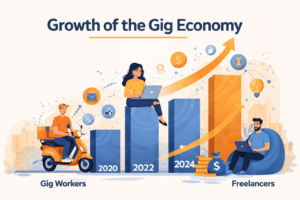
Growth of the Gig Economy
The gig economy has grown rapidly due to several factors:
1. Digital Platforms
Apps and online marketplaces have made it easier to connect workers with clients or customers.
2. Changing Work Preferences
Many individuals prefer flexible schedules over traditional employment.
3. Cost Efficiency for Businesses
Companies save on long-term employee costs by hiring gig workers.
4. Pandemic Impact
COVID-19 accelerated remote work and freelancing opportunities.
In India alone, millions of people are engaged in gig work, and the number is expected to grow significantly in the coming years.
Challenges Faced by Gig Workers and Freelancers
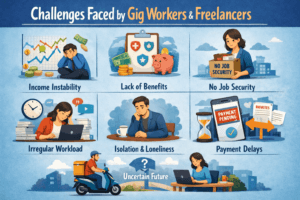
Despite its growth, the gig economy presents several challenges:
1. Income Instability
Gig workers often face irregular earnings, making financial planning difficult.
2. Lack of Social Security
Unlike traditional employees, they usually do not receive:
- Provident Fund (PF)
- Employee State Insurance (ESI)
- Paid leave
3. Limited Legal Protection
Gig workers may not be classified as “employees,” which limits their rights and protections.
4. No Health or Accident Insurance
Many gig workers are exposed to risks without adequate coverage.
5. Difficulty Accessing Credit
Without stable income proof, getting loans or credit cards can be challenging.
6. Platform Dependency
Workers often rely heavily on a single platform, which can change policies or payment structures at any time.
Government intervention is essential to ensure that gig workers are not left behind in the evolving economy. Support from the government can:
- Provide financial security
- Ensure access to healthcare
- Protect workers’ rights
- Encourage skill development
- Promote economic stability
Without such support, a large section of the workforce remains vulnerable.
Government Initiatives in India
India has taken several steps to support gig workers and freelancers.
1. Code on Social Security, 2020
This is one of the most significant reforms in India.
- Recognizes gig workers and platform workers
- Proposes social security schemes for them
- Enables benefits like insurance, maternity support, and pensions
Although implementation is ongoing, this law is a major step forward.
2. e-Shram Portal
The e-Shram portal was launched to create a national database of unorganized workers, including gig workers.
Key features:
- Free registration
- Unique e-Shram card
- Access to government schemes
- Accident insurance coverage
This helps the government track and support workers more effectively.
3. Pradhan Mantri Shram Yogi Maandhan (PMSYM)
This pension scheme is designed for unorganized workers.
Benefits:
- Monthly pension after age 60
- The government contributes equally to the worker’s contribution
Gig workers can enroll and secure their future financially.
4. Ayushman Bharat (PM-JAY)
This scheme provides health insurance coverage to low-income families.
- Covers hospitalization expenses
- Helps gig workers manage medical emergencies
5. Skill Development Programs
Programs like Skill India and Digital India help freelancers and gig workers improve their skills and increase earning potential.
6. State-Level Initiatives
Some Indian states have also introduced policies:
- Rajasthan: Welfare board for gig workers
- Karnataka: Proposed protections and benefits for platform workers
These initiatives aim to provide localized support.

Global Examples of Government Support
Many countries are also taking steps to support gig workers:
United States
- Some states provide unemployment benefits for gig workers
- Discussions on classifying gig workers as employees
United Kingdom
- Court rulings have granted gig workers rights like minimum wage and paid leave
European Union
- Proposals to improve working conditions and transparency in digital platforms
These global efforts highlight the importance of protecting gig workers.
While governments play a key role, digital platforms must also contribute.
Responsibilities of Platforms:
- Fair payment systems
- Transparent policies
- Insurance coverage
- Dispute resolution mechanisms
Collaboration between governments and platforms is crucial for effective support.
Although progress has been made, several improvements are needed:
1. Clear Legal Status
Gig workers should have a well-defined legal classification.
2. Universal Social Security
Access to healthcare, pensions, and insurance should be ensured.
3. Income Protection
Minimum earning guarantees or wage standards can help.
4. Easier Access to Credit
Special financial products for gig workers can improve their financial inclusion.
5. Awareness Campaigns
Many workers are unaware of existing schemes. Better awareness is needed.
6. Data Protection
Workers’ data should be safeguarded from misuse.

Future of Gig Work
The gig economy is expected to grow even further with advancements in technology such as AI, automation, and digital platforms.
Future trends include:
- More remote freelancing opportunities
- Increased competition
- Greater need for skill specialization
Government policies will play a crucial role in shaping this future.
Conclusion
Gig workers and freelancers are an essential part of the modern economy. They bring flexibility, innovation, and efficiency to various industries. However, their contributions often come without the security and benefits enjoyed by traditional employees.
Government support is not just helpful—it is necessary. Through policies like the Code on Social Security, the e-Shram portal, and various welfare schemes, India has begun to address the needs of gig workers. Still, there is a long way to go.
A balanced approach involving governments, digital platforms, and workers themselves can create a more secure and inclusive gig economy. With the right support systems in place, gig workers and freelancers can thrive and contribute even more effectively to economic growth.