
Complete Guide to Government Certificates in India: Apply, Download & Update Online
Government certificates play a crucial role in the life of every Indian citizen. Whether it’s for education, employment, financial services, or accessing welfare schemes, these documents serve as official proof of identity, eligibility, and status. Over the past decade, India has made significant progress in digitizing public services, making it easier than ever to apply, download, and update certificates online.
This guide walks you through everything you need to know about government certificates in India—what they are, why they matter, and how you can access them easily from the comfort of your home.
Here is what you want: How to Check If You Are Eligible for Multiple Government Schemes at Once
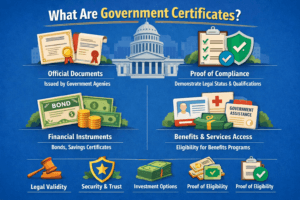
What Are Government Certificates?
Government certificates are official documents issued by central, state, or local authorities to certify specific information about an individual. These may include identity, residence, income, caste, birth details, or educational qualifications.
These certificates are often required for:
- School and college admissions
- Government job applications
- Subsidies and welfare schemes
- Passport and visa applications
- Property and legal documentation
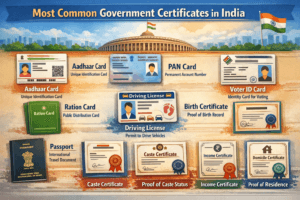
Most Common Government Certificates in India
Let’s look at some of the most widely used certificates:
1. Birth Certificate
This is one of the first official documents issued to an individual. It records the date and place of birth and is essential for school admissions, passports, and identity proofs.
2. Death Certificate
Issued after a person’s demise, this certificate is necessary for legal procedures like inheritance, insurance claims, and pension settlements.
3. Caste Certificate
This document certifies whether a person belongs to Scheduled Castes (SC), Scheduled Tribes (ST), or Other Backward Classes (OBC). It is crucial for availing reservations and benefits.
4. Income Certificate
It reflects an individual’s or family’s annual income and is often required to access scholarships, fee concessions, and government schemes.
5. Domicile Certificate
This certificate proves that a person is a resident of a particular state or union territory. It is important for state-specific benefits and quotas.
6. Marriage Certificate
Issued to legally validate a marriage, this certificate is useful for legal, financial, and immigration purposes.
7. Aadhaar Card
Though technically an identity card, Aadhaar functions as a universal ID and is widely used for verification in government and private services.
8. PAN Card
Issued by the Income Tax Department, PAN is essential for financial transactions, filing taxes, and opening bank accounts.
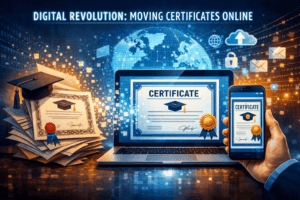
Digital Revolution: Moving Certificates Online
India’s push toward Digital India has transformed how citizens access government services. Earlier, people had to visit government offices, stand in long queues, and deal with paperwork. Today, most certificates can be applied for and accessed online.
Key platforms include:
- DigiLocker—A secure cloud-based platform for storing and accessing documents
- UMANG App—Provides access to multiple government services in one place
- State e-District Portals—Each state offers online services for certificates
- Aadhaar-based e-KYC systems
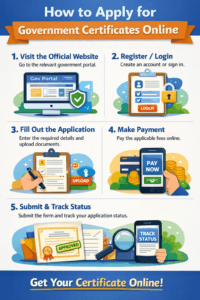
How to Apply for Government Certificates Online
The process may vary slightly depending on the state and certificate type, but the general steps are similar.
Step 1: Visit the Official Portal
Go to the relevant website, such as your state’s e-District portal or national platforms like DigiLocker or UMANG.
Step 2: Register/Login
Create an account using your mobile number or Aadhaar. Verify your identity through OTP.
Step 3: Choose the Certificate
Select the type of certificate you want to apply for (e.g., income certificate, caste certificate).
Step 4: Fill in the Application Form
Provide necessary details such as name, address, date of birth, and other required information.
Step 5: Upload Documents
Submit scanned copies of supporting documents like Aadhaar, ration card, or proof of income.
Step 6: Pay Fees (if applicable)
Some services require a nominal fee, which can be paid online.
Step 7: Submit and Track
After submission, you’ll receive an application number. Use it to track the status.
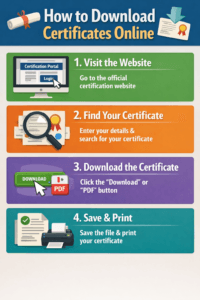
How to Download Certificates Online
Once your certificate is approved, downloading it is simple.
Method 1: Through State Portal
- Log in to the same portal where you applied
- Go to “Issued Documents” or “Download Certificate.”
- Enter your application/reference number
- Download the PDF
Method 2: Using DigiLocker
- Sign in to DigiLocker
- Search for the issuing authority
- Link your details (like Aadhaar)
- Access and download your certificate instantly
How to Update or Correct Certificates
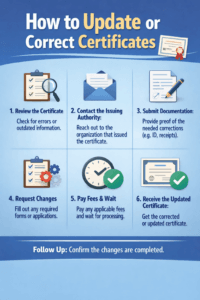
Mistakes in certificates can cause serious issues, so correcting them promptly is important.
Steps to Update:
- Visit the official portal
- Select “Correction” or “Update Certificate.”
- Enter certificate details
- Upload supporting documents
- Submit the request
Some updates may require physical verification, depending on the type of certificate.
Documents Required for Different Certificates
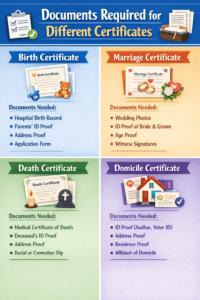
Here are some commonly required documents:
- Aadhaar Card
- Voter ID
- Ration Card
- Passport-size photographs
- Utility bills (for address proof)
- School certificates (for age proof)
- Income proof (salary slip, IT return)
Benefits of Online Certificate Services
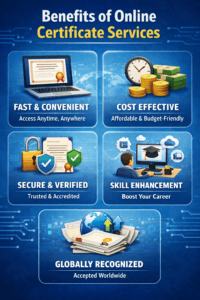
The shift to online systems offers several advantages:
1. Convenience
You can apply from anywhere, anytime, without visiting offices.
2. Time-Saving
No more long queues or multiple visits.
3. Transparency
Track your application status in real-time.
4. Reduced Corruption
Minimizes middlemen and unofficial charges.
5. Secure Storage
Platforms like DigiLocker keep documents safe and easily accessible.
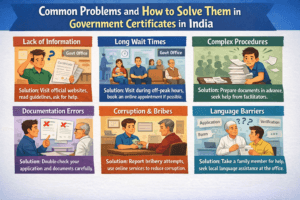
Common Problems and How to Solve Them
Despite improvements, users may still face issues:
Problem 1: Application Rejected
Solution: Check for missing or incorrect documents and reapply.
Problem 2: Delay in Approval
Solution: Contact the concerned department or use grievance portals.
Problem 3: Login Issues
Solution: Reset password or verify mobile number.
Problem 4: Document Mismatch
Solution: Ensure all details match your Aadhaar and other records.
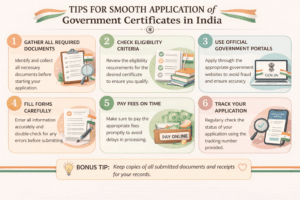
Tips for Smooth Application
- Always use official government websites
- Double-check all details before submission
- Keep scanned documents ready in required formats
- Save your application/reference number
- Regularly track your application status
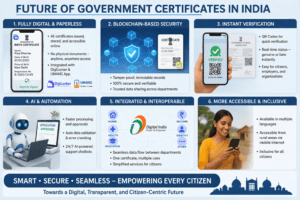
Future of Government Certificates in India
India is rapidly moving toward a paperless governance system. With initiatives like Digital India, e-Governance, and Aadhaar integration, accessing certificates is becoming faster and more secure.
In the near future, we can expect:
- Fully automated approvals
- Blockchain-based document verification
- Increased use of AI for processing applications
- Greater integration between departments
Conclusion
Government certificates are essential documents that impact various aspects of life in India. Thanks to digital advancements, applying, downloading, and updating these certificates has become simpler and more efficient.
By understanding the process and using the right platforms, you can save time, avoid hassles, and ensure that your documents are always up-to-date. Whether you are a student, job seeker, or beneficiary of government schemes, knowing how to manage your certificates online is an important life skill in today’s digital age.
1 thought on “Complete Guide to Government Certificates in India: Apply, Download & Update Online”