
Skill Loan Scheme in India: Eligibility, Benefits & How to Apply Online
In a rapidly evolving economy like India, skill development has become a crucial pathway to employment and entrepreneurship. While traditional education remains important, vocational training and skill-based courses are increasingly gaining recognition for their practical value. However, financial constraints often prevent many aspiring learners from accessing such training. To address this gap, the Government of India introduced the Skill Loan Scheme, a targeted initiative aimed at providing financial support to individuals pursuing skill development programs.
This article offers a comprehensive understanding of the Skill Loan Scheme in India, including its objectives, eligibility criteria, benefits, application process, and key considerations.
What is the Skill Loan Scheme?
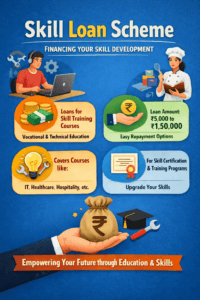
The Skill Loan Scheme is a government-backed financial assistance program designed to support individuals who wish to enroll in skill development courses. It was introduced by the Ministry of Skill Development and Entrepreneurship in collaboration with the Indian Banks’ Association (IBA).
The scheme provides loans to students for vocational education and training programs, helping them acquire industry-relevant skills without the burden of immediate financial pressure.
Unlike traditional education loans, the Skill Loan Scheme specifically focuses on short-term and medium-term skill-based courses aligned with the National Skill Qualification Framework (NSQF).
Objectives of the Skill Loan Scheme
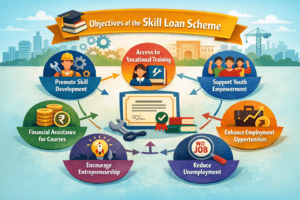
The primary goals of the scheme include:
- Promoting skill development among youth
- Increasing employability and job readiness
- Supporting financially weaker sections
- Encouraging entrepreneurship and self-employment
- Bridging the gap between education and industry requirements
By making skill training accessible and affordable, the scheme aims to contribute to India’s vision of becoming a skilled workforce hub.
Key Features of the Skill Loan Scheme
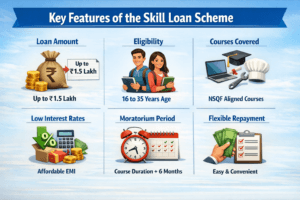
1. Loan Amount
The loan amount under the Skill Loan Scheme ranges from:
- Minimum: ₹5,000
- Maximum: ₹1,50,000
The amount depends on the course duration, type of training, and associated costs.
2. No Collateral Required
One of the biggest advantages of this scheme is that no collateral or security is required. This makes it accessible to students from economically weaker backgrounds.
3. Flexible Repayment Tenure
Repayment typically starts after the completion of the course and a moratorium period. The repayment tenure varies depending on the loan amount:
- Up to ₹50,000: up to 3 years
- ₹50,000 to ₹1 lakh: up to 5 years
- Above ₹1 lakh: up to 7 years
4. Moratorium Period
Borrowers are given a moratorium period that includes:
- Course duration
- Additional 6 months
This allows time to secure employment before starting repayment.
5. Coverage of Expenses
The loan covers various expenses, including:
- Course fees
- Examination fees
- Certification charges
- Books and equipment
Eligibility Criteria
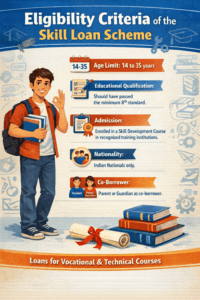
To apply for the Skill Loan Scheme, applicants must meet the following conditions:
1. Nationality
- Must be an Indian citizen
2. Age Criteria
- No strict age limit, but applicants should meet bank-specific requirements
3. Course Eligibility
- Must be enrolled in a recognized skill development course
- The course should be aligned with NSQF or offered by:
- Industrial Training Institutes (ITIs)
- Polytechnics
- Training partners under government schemes
- Sector Skill Councils
4. Admission Confirmation
- The applicant must have secured admission before applying for the loan
5. Credit Requirements
- Basic KYC compliance
- A co-applicant may be required depending on the bank

Benefits of the Skill Loan Scheme
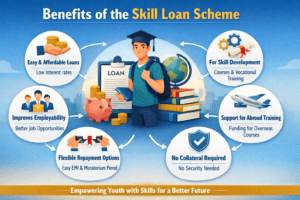
1. Financial Accessibility
The scheme ensures that even students from low-income families can access skill training without upfront financial stress.
2. Encourages Skill-Based Careers
It promotes vocational education, which is often overlooked despite its high employability potential.
3. Quick Processing
Compared to traditional education loans, skill loans are processed faster due to smaller loan amounts.
4. No Collateral Burden
Students do not need to pledge assets, reducing financial risk for families.
5. Supports Entrepreneurship
Many skill courses lead to self-employment opportunities, helping individuals start their own businesses.
Interest Rates and Charges
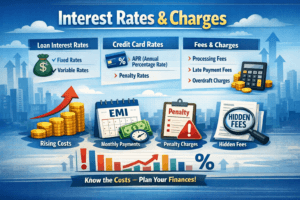
Interest rates under the Skill Loan Scheme are generally linked to the bank’s base rate or MCLR. While rates may vary across banks, they are usually affordable and competitive.
Some banks may offer concessions for:
- Female applicants
- Economically weaker sections
- Government-sponsored training programs
It is advisable to compare interest rates across banks before applying.
How to Apply for Skill Loan Scheme Online
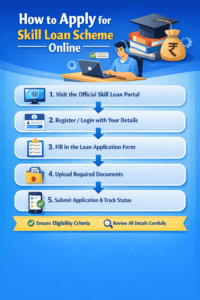
Applying for a skill loan is a straightforward process. Here is a step-by-step guide:
Step 1: Choose a Course
Select a recognized skill development course aligned with NSQF or approved institutions.
Step 2: Select a Bank
Visit the websites of participating banks such as SBI, Bank of Baroda, or other public/private sector banks.
Step 3: Fill Out the Application Form
Complete the online education loan or skill loan application form.
Step 4: Upload Documents
Submit required documents such as:
- Identity proof (Aadhaar, PAN)
- Address proof
- Admission letter
- Course details
- Passport-size photographs
Step 5: Verification Process
The bank will verify your documents and eligibility.
Step 6: Loan Approval
Once approved, the loan amount is disbursed directly to the training institution.
Offline Application Process
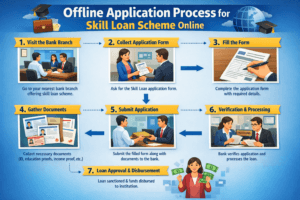
Applicants can also apply offline by visiting the nearest bank branch and submitting a physical application form along with required documents.
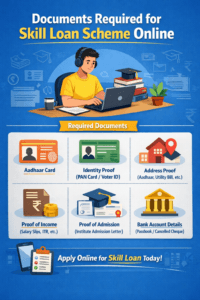
Documents Required
Typical documents include:
- Aadhaar Card
- PAN Card
- Passport-size photographs
- Admission letter from institute
- Fee structure
- Bank statements (if required)
- Co-applicant documents (if applicable)

Participating Banks
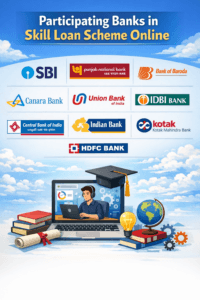
Several banks in India offer loans under this scheme, including:
- State Bank of India (SBI)
- Bank of Baroda
- Punjab National Bank (PNB)
- Canara Bank
- Union Bank of India
Private banks and NBFCs may also provide similar loan options.
Important Tips Before Applying
- Verify that the course is recognized under NSQF
- Compare interest rates and repayment terms
- Ensure all documents are accurate and complete
- Understand the repayment schedule clearly
- Choose a course with strong employment prospects
Challenges of the Skill Loan Scheme
While the scheme is beneficial, there are certain challenges:
- Limited awareness among students
- Variations in bank policies
- Delays in loan approval in some cases
- Limited loan amount for advanced courses
Addressing these challenges can further enhance the effectiveness of the scheme.
Future of Skill Loans in India
With initiatives like Skill India and Digital India, the demand for skilled professionals is expected to grow significantly. The Skill Loan Scheme is likely to play a vital role in:
- Expanding vocational training access
- Supporting startup culture
- Enhancing workforce productivity
Government efforts to increase awareness and streamline processes can further strengthen the scheme’s impact.
Conclusion
The Skill Loan Scheme in India is a powerful initiative that bridges the gap between financial limitations and skill development opportunities. By providing affordable and collateral-free loans, it empowers individuals to pursue vocational training and build sustainable careers.
Whether you aim to secure a job or start your own business, this scheme can be a stepping stone toward achieving your goals. Understanding its eligibility, benefits, and application process can help you make informed decisions and take full advantage of this opportunity.
1 thought on “Skill Loan Scheme in India: Eligibility, Benefits & How to Apply Online”