The New Reservation Policy Explained: Key Changes, Eligibility, and Impact
India’s reservation policy has long been one of the most discussed and debated aspects of the country’s social and political framework. Designed as a mechanism to address historical discrimination and social inequality, the reservation system provides opportunities in education, government employment, and political representation to communities that have faced social and economic disadvantages for generations.
Over the years, this policy has undergone several changes. With the addition of the Economically Weaker Sections (EWS) category and continued discussions around eligibility, expansion, and implementation, many people are asking an important question: what exactly is the new reservation policy, and how does it affect ordinary citizens?
This article explains the current reservation policy in India, the major recent changes, eligibility rules, benefits, criticism, and the impact on students, job seekers, and society.
Yet don’t know about West Bengal BPL Card Eligibility 2026: Criteria, Benefits, and Income Limits Explained
Understanding India’s Reservation Policy
Reservation in India is a system of affirmative action created to improve representation for historically disadvantaged communities. The idea behind reservation is not simply to provide benefits but to create equal opportunities for groups that have traditionally been excluded from education, employment, and decision-making spaces.
The Indian Constitution provides the legal basis for reservation through several provisions.
Important constitutional articles include:
- Article 15 – allows special provisions for socially and educationally backward classes, Scheduled Castes, and Scheduled Tribes.
- Article 16 – provides reservation in public employment.
- Article 46 – directs the state to promote educational and economic interests of weaker sections.
- Articles 330 and 332 – provide political reservation in legislatures.
The reservation system was originally introduced as a temporary measure after independence, but it has continued due to ongoing social disparities.
Major Categories Under the Current Reservation Policy
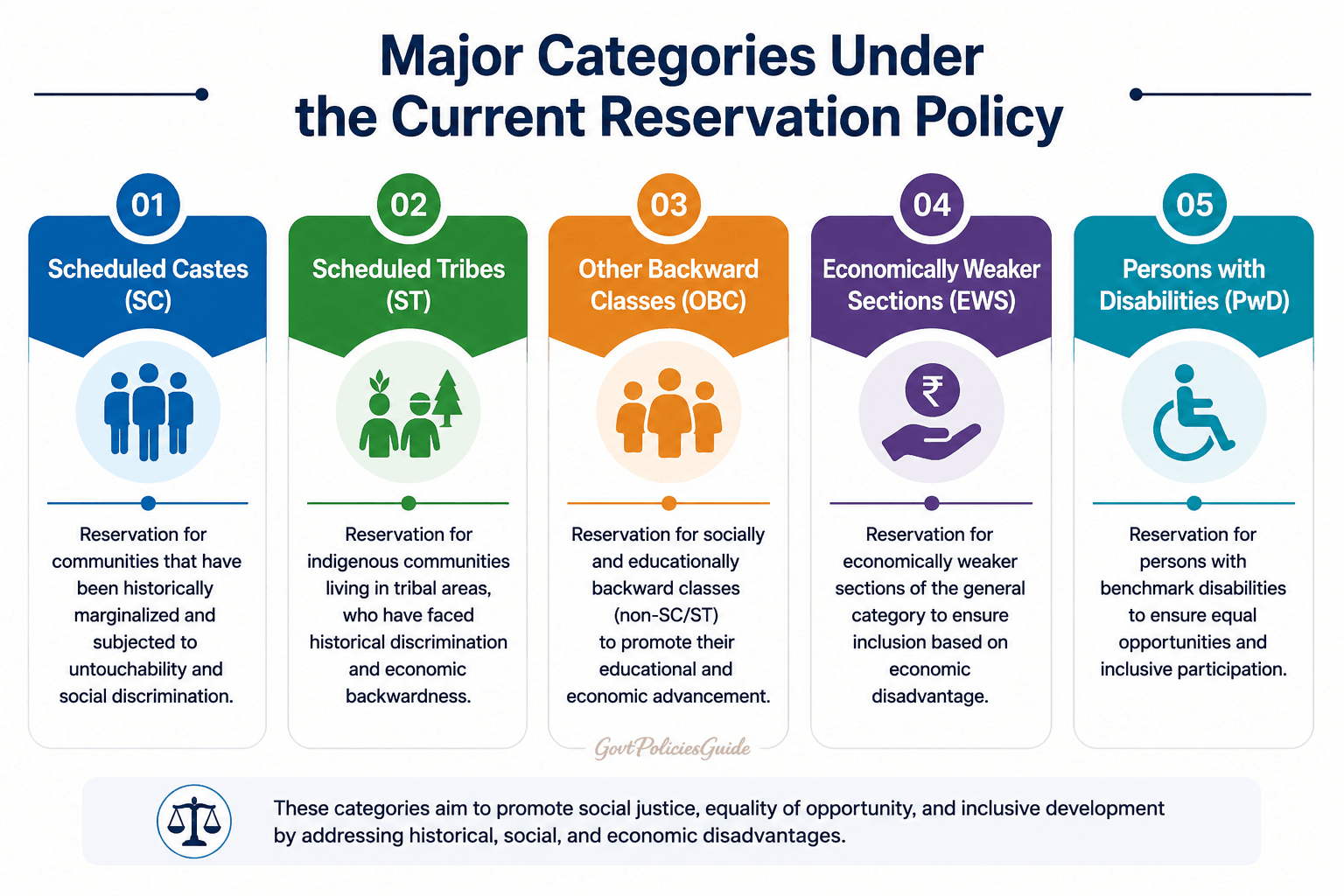
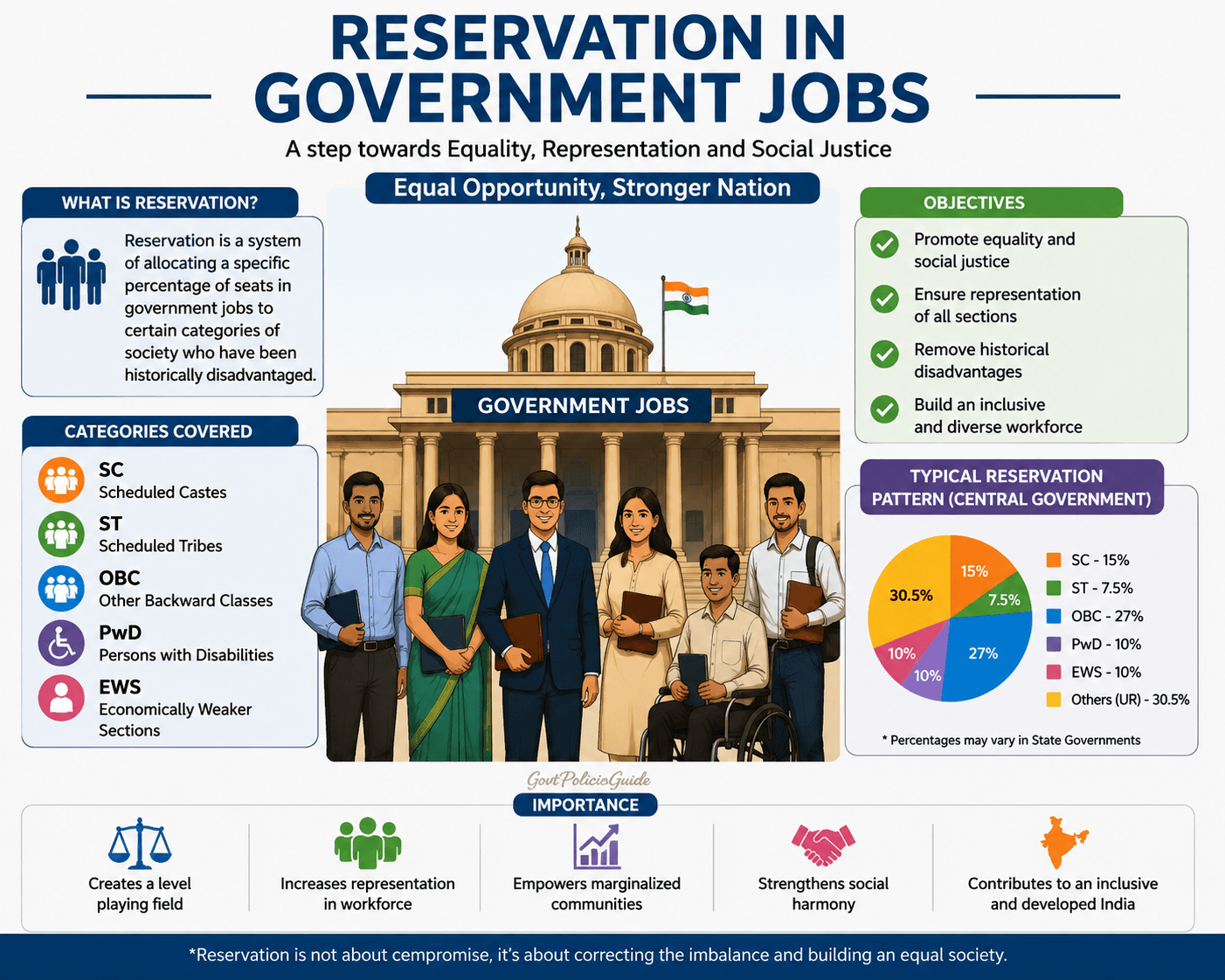
India’s reservation structure mainly includes four broad categories.
Scheduled Castes (SC)
Scheduled Castes are communities that historically faced untouchability and severe social discrimination.
Reservation benefits:
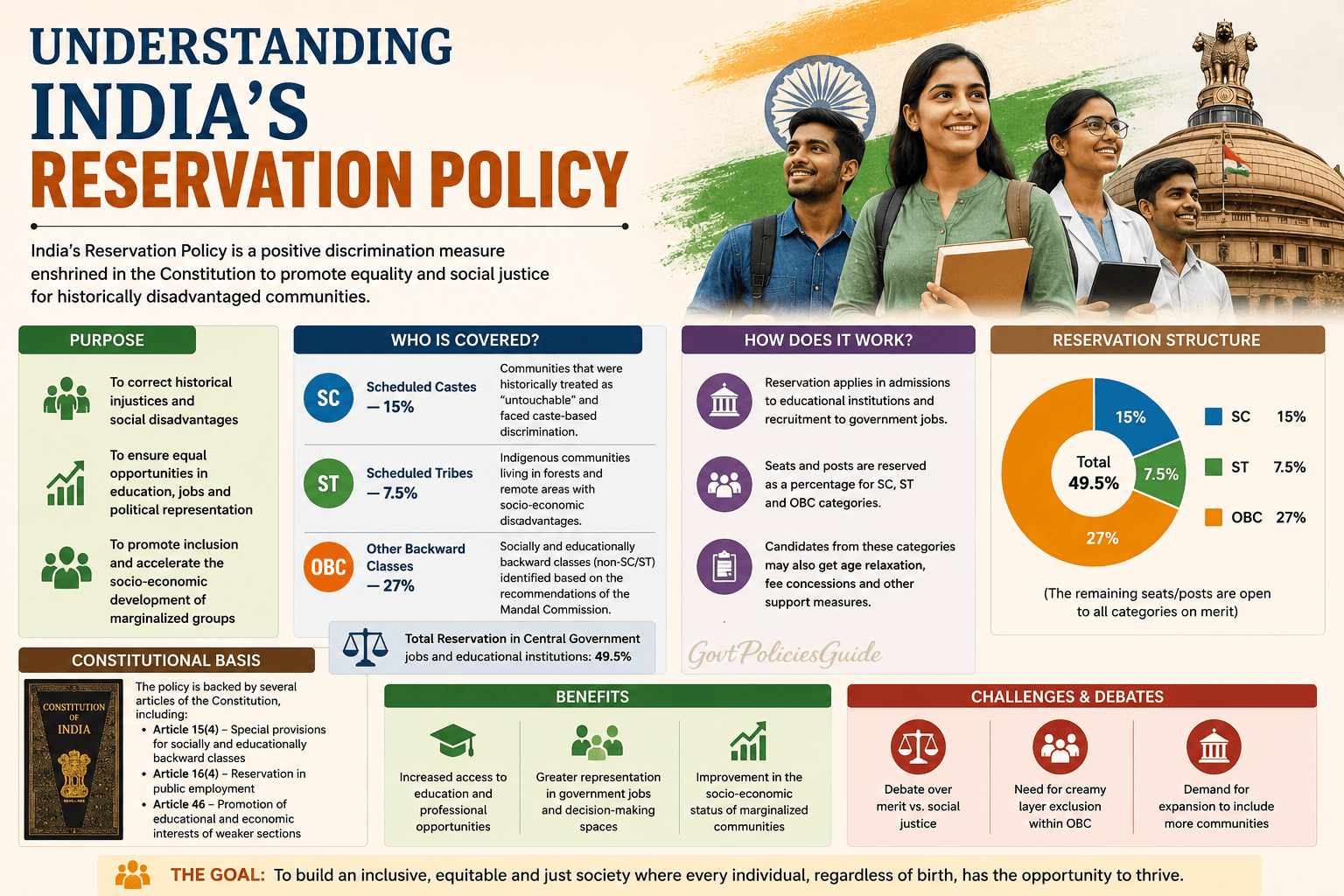
- 15% reservation in central government jobs
- 15% reservation in educational institutions
Eligibility:
A person must belong to a caste listed as Scheduled Caste by the Government of India.
Scheduled Tribes (ST)
Scheduled Tribes include indigenous communities that have historically faced geographic isolation, economic disadvantage, and lack of access to resources.
Reservation benefits:
- 7.5% reservation in central government jobs
- 7.5% reservation in educational institutions
Eligibility:
A person must belong to a recognized Scheduled Tribe.
Other Backward Classes (OBC)
OBC reservation is meant for socially and educationally backward communities that are not included under SC or ST.
Reservation benefits:
- 27% reservation in central government jobs
- 27% reservation in central educational institutions
Eligibility:
Candidates must belong to approved OBC communities and satisfy non-creamy layer conditions where applicable.
Economically Weaker Sections (EWS)
EWS is one of the biggest recent changes in India’s reservation policy.
Introduced through the 103rd Constitutional Amendment, EWS reservation provides benefits to economically weaker individuals from communities not already covered under SC, ST, or OBC reservations.
Reservation benefits:
- 10% reservation in education
- 10% reservation in government jobs
Eligibility generally includes:
- Annual family income below prescribed limit
- Asset ownership conditions
- Exclusion of SC/ST/OBC beneficiaries
What Changed in the New Reservation Policy?
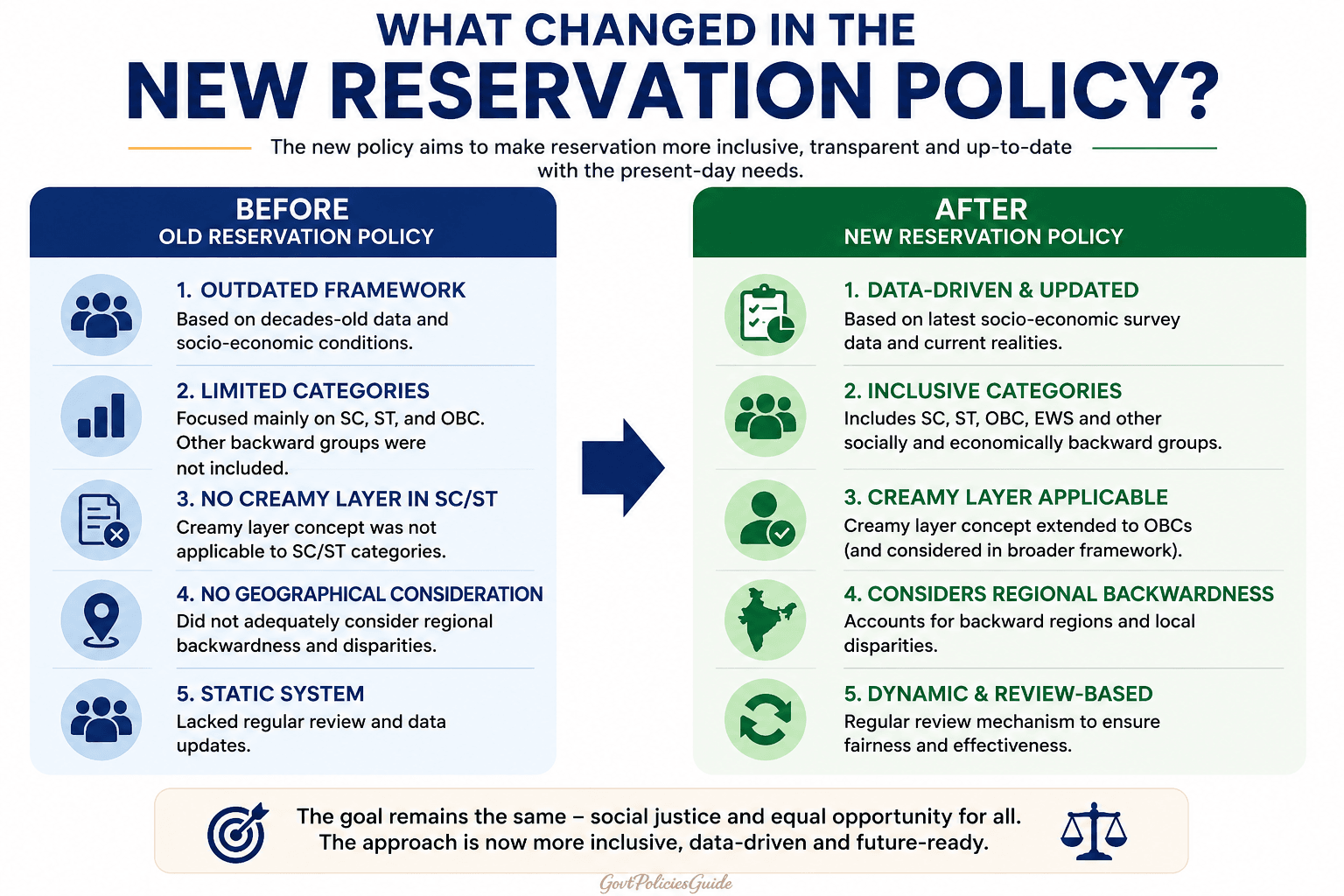
India’s reservation framework has evolved significantly. Several key changes define what many refer to as the new reservation policy.
1. Introduction of EWS Reservation
The biggest structural change was the addition of the EWS quota.
Before this change, reservation was largely based on social and educational backwardness. EWS introduced economic criteria as a major factor.
This expanded the reservation system to include economically disadvantaged individuals from the general category.
Why this matters:
- Broader inclusion
- Support for financially weaker families
- Shift in policy thinking
Criticism:
Some argue reservation should remain focused on social disadvantage rather than income alone.
2. Crossing the Traditional 50% Reservation Limit
Historically, the Supreme Court had indicated that reservation should generally remain within 50%.
With the addition of EWS, total reservation in many cases crossed this limit.
This became a major constitutional debate.
Supporters argued:
- Economic disadvantage deserves recognition
- Social justice frameworks must evolve
Opponents argued:
- Merit could be affected
- Constitutional principles may be diluted
The Supreme Court later upheld the EWS reservation framework.
3. Stricter OBC Verification
Another important development has been stronger scrutiny around OBC eligibility.
This includes:
- Non-creamy layer verification
- Income certification
- Updated documentation requirements
The goal is to ensure benefits reach genuinely eligible candidates.
4. Expanded State-Level Reservation Experiments
Different states have proposed or implemented additional reservation models.
Examples include:
- Caste-based quota adjustments
- Regional quotas
- Community-specific reservations
State-level policies continue to create variation across India.
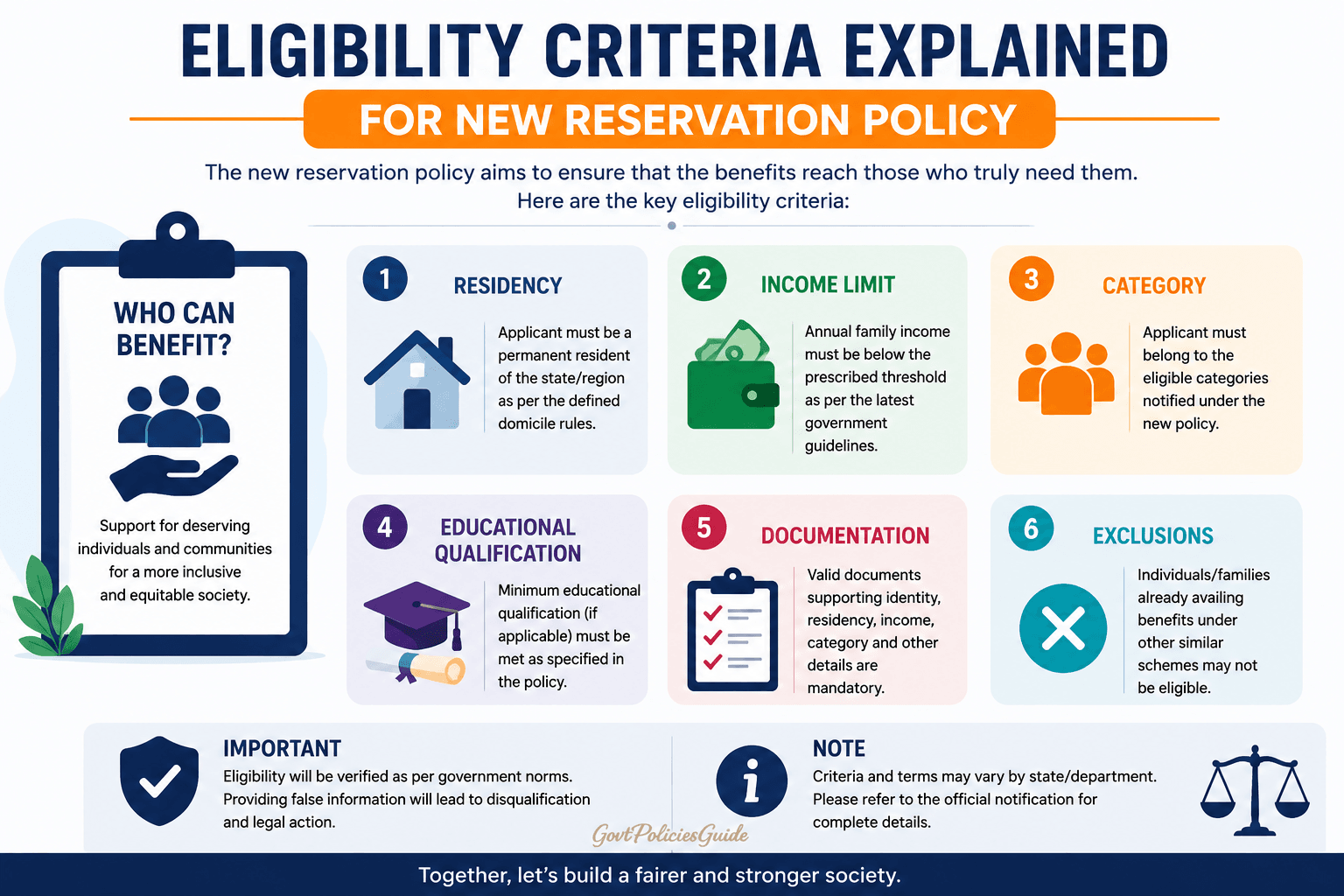
Eligibility Criteria Explained
Understanding eligibility is essential because not everyone automatically qualifies.
SC Eligibility
Requirements:
- Belong to officially listed Scheduled Caste
- Valid caste certificate
- Recognition under relevant jurisdiction
ST Eligibility
Requirements:
- Belong to recognized tribal community
- Valid tribal certificate
- Compliance with local authority rules
OBC Eligibility
Requirements:
- Belong to listed OBC category
- Meet non-creamy layer requirements
- Valid OBC certificate
Non-creamy layer generally excludes higher-income families from certain OBC reservation benefits.
EWS Eligibility
Common requirements:
- Annual family income below prescribed threshold
- No ownership of high-value residential property
- No large land ownership
- Not belonging to SC/ST/OBC categories
Specific implementation rules may vary.
Reservation in Education
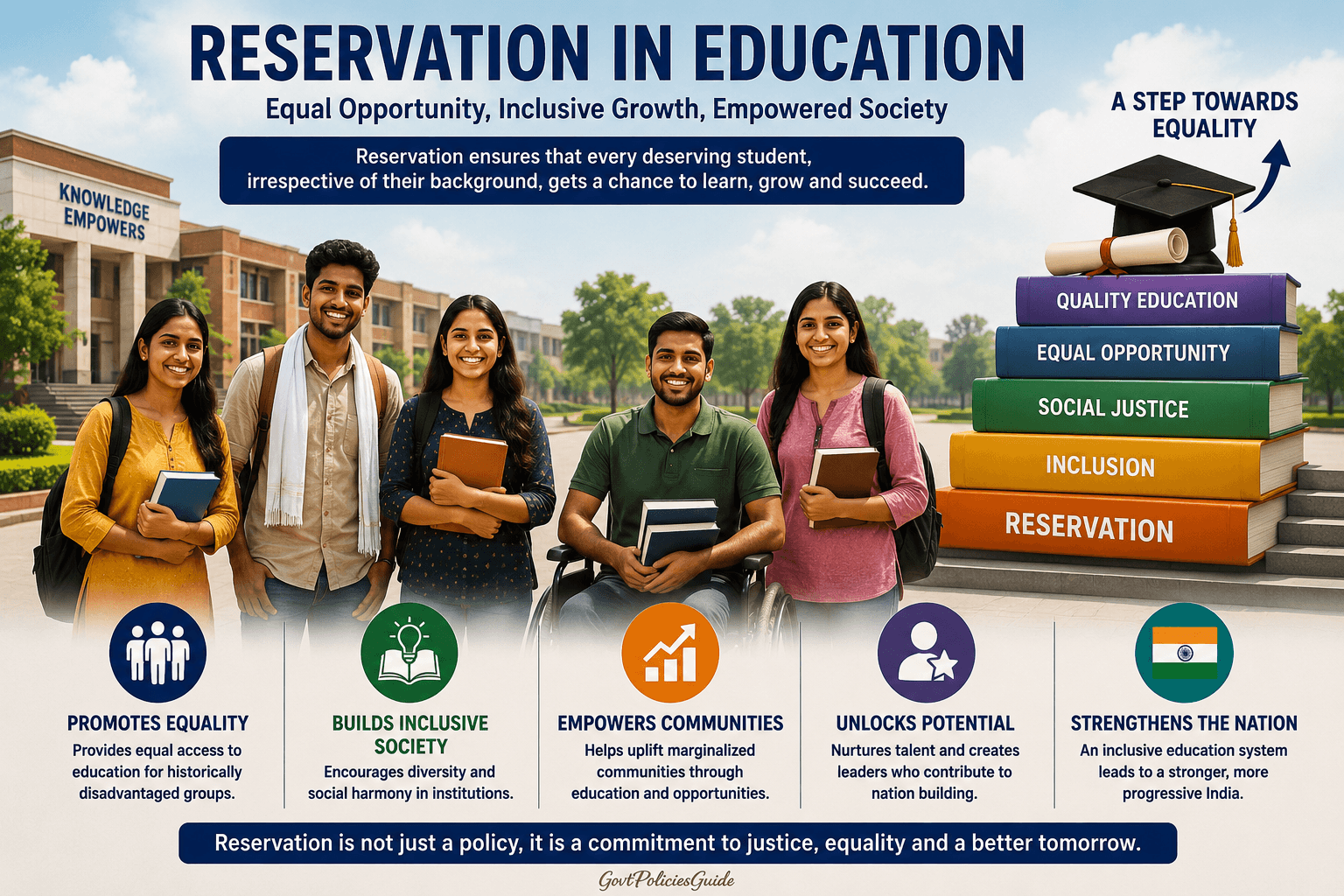
Reservation significantly affects admissions to educational institutions.
Covered institutions often include:
- Central universities
- IITs
- NITs
- Medical colleges
- Government colleges
Benefits may include:
- Reserved seats
- Relaxed cutoffs
- Scholarship access
Impact on students:
Greater access for underrepresented communities.
Challenges:
Competition remains intense.
Reservation in Government Jobs
Reservation applies in many government recruitment processes.
Examples:
- UPSC-related posts
- SSC recruitment
- Railways
- Public sector jobs
- State government positions
Possible benefits:
- Reserved vacancies
- Relaxation in age limits
- Reduced application fees
- Lower qualifying marks in some cases
Impact:
Improved representation in public employment.
Reservation in Promotions
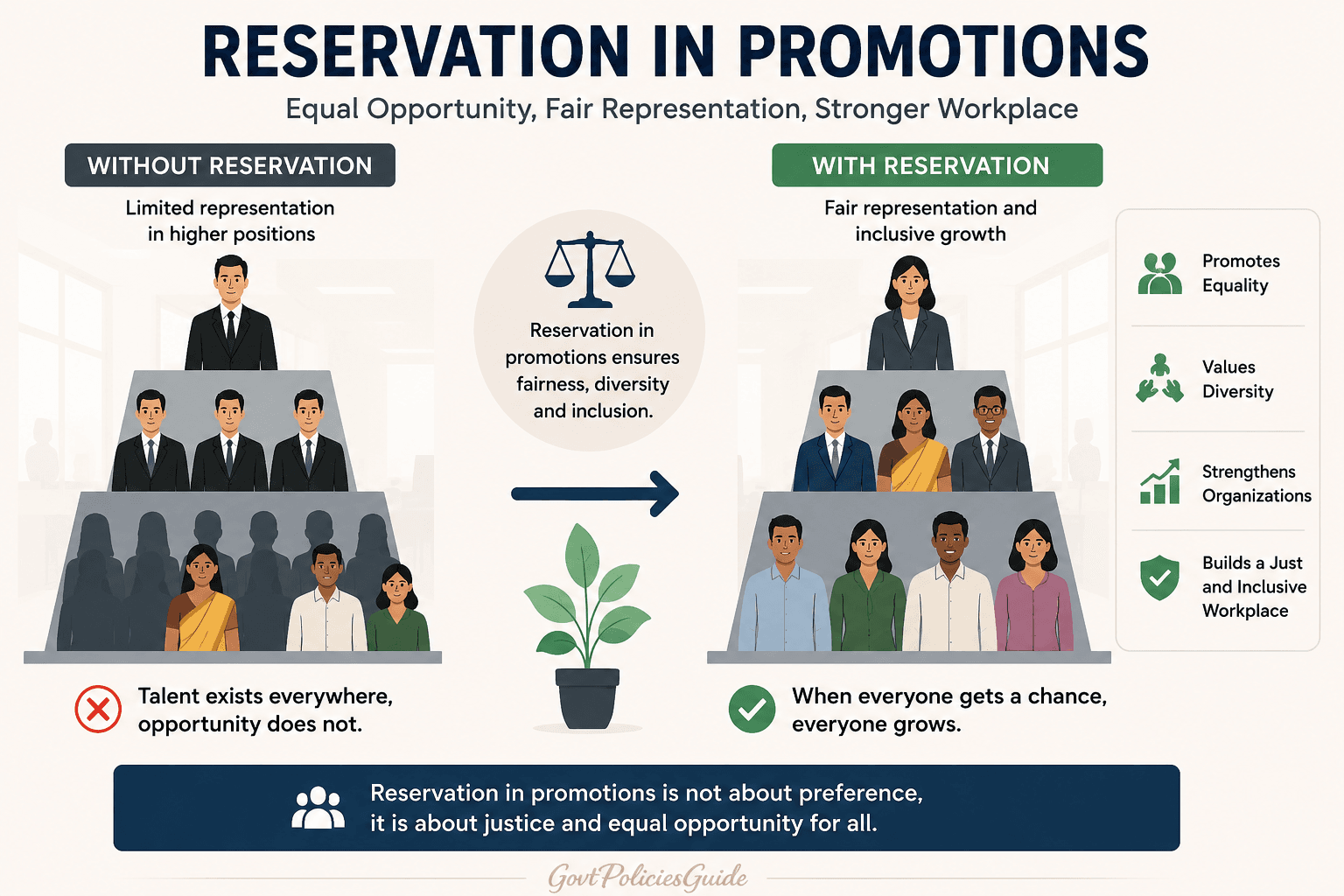
Reservation in promotions has remained legally and politically complex.
Some policies permit promotion benefits under certain conditions.
Debates involve:
- Administrative efficiency
- Fair representation
- Constitutional interpretation
Court rulings continue shaping implementation.
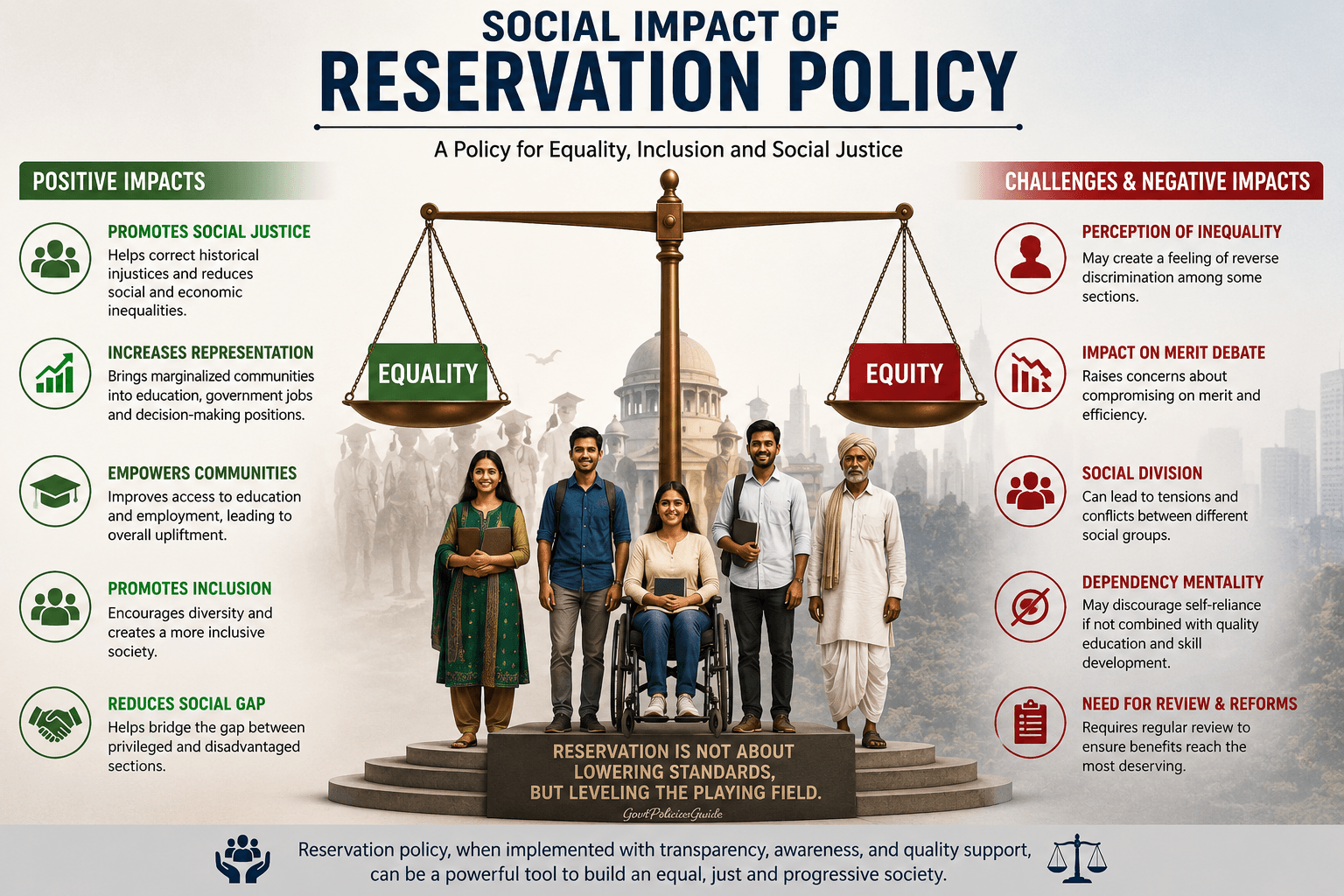
Social Impact of Reservation Policy
The reservation system has deeply influenced Indian society.
Positive effects:
Improved Representation
Communities previously excluded from education and governance now have greater visibility.
Educational Mobility
Students from disadvantaged backgrounds can access higher education.
Economic Progress
Government employment can significantly improve family income and stability.
Social Inclusion
Reservation has increased participation in mainstream institutions.
Economic Impact
Reservation has both direct and indirect economic effects.
Positive outcomes:
- Increased workforce diversity
- Better household financial security
- Reduced intergenerational poverty
Concerns:
- Debate over merit-based competition
- Administrative complexity
- Verification burden
Political Impact
Reservation remains a major political issue.
Political consequences include:
- Electoral promises
- Community mobilization
- Constitutional amendments
- Legal challenges
It influences national and state elections significantly.Criticism of the Reservation System
Reservation also attracts criticism.
Common concerns include:
Merit Debate
Some argue reservation reduces competition fairness.
Counterargument:
Merit is shaped by access to education, resources, and opportunity.
Dependency Concerns
Critics worry prolonged reservation can create dependency.
Supporters argue structural inequality still exists.
Exclusion Errors
Some genuinely deserving people may miss benefits due to documentation or classification issues.
Creamy Layer Concerns
Questions remain over whether better-off beneficiaries continue receiving advantages.
Future of Reservation Policy
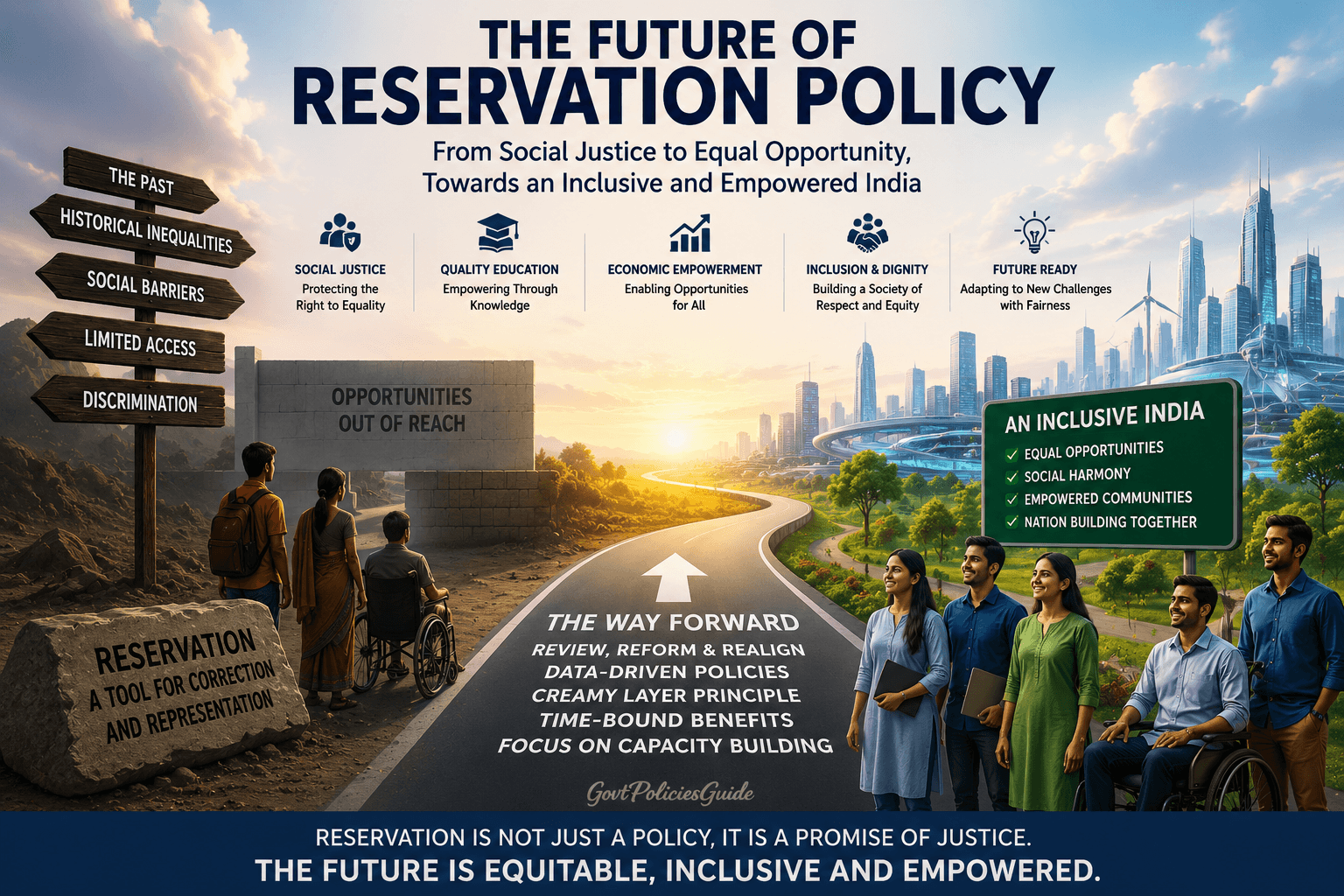
Several debates may shape future reforms.
Possible developments:
- Caste census-based changes
- Expanded economic criteria
- Private sector reservation discussions
- New backward class classifications
- State-specific quota revisions
Reservation policy will likely continue evolving.
Real-Life Example
Imagine two students.
Student A comes from an urban family with stable schooling, coaching support, internet access, and educated parents.
Student B comes from a socially marginalized rural background with weak school infrastructure and financial limitations.
Even if both take the same exam, their starting points are unequal.
Reservation attempts to reduce this inequality.
Common Misconceptions
Reservation Means Guaranteed Success
False.
Reservation provides opportunity, not guaranteed selection.
Only Poor People Get Reservation
Not entirely true.
Some categories are based on social disadvantage, not just income.
General Category Gets No Benefits
Not accurate.
EWS provides opportunities for eligible economically weaker candidates.
Public Debate Around “Merit vs Social Justice”
This remains one of India’s strongest policy debates.
One perspective:
Selection should be purely marks-based.
Another perspective:
Equal competition requires equal starting conditions.
The policy attempts to balance both.
Legal Background
Important legal milestones include:
- Mandal Commission implementation
- Indra Sawhney judgment
- 103rd Constitutional Amendment
- Supreme Court validation of EWS quota
These decisions shaped today’s framework.
Challenges in Implementation
Real-world problems include:
- Fake caste certificates
- Delayed verification
- State-central differences
- Legal uncertainty
- Public confusion
Administrative reforms remain necessary.
Who Benefits Most?
Groups benefiting significantly:
- Historically marginalized communities
- Rural applicants
- First-generation learners
- Economically weaker families
- Government job aspirants
Is Reservation Permanent?
Technically, reservation policies can evolve through legislation, constitutional amendments, and judicial review.
Public demand and political decisions heavily influence continuation.
Conclusion
India’s new reservation policy reflects both continuity and change.
Traditional reservations for SC, ST, and OBC communities remain central to the system, while the addition of EWS has expanded the conversation beyond social backwardness to economic disadvantage.
Supporters see reservation as essential for justice, representation, and equal opportunity. Critics raise questions about merit, efficiency, and long-term dependence.
The reality lies somewhere in a complex middle ground.
India remains a deeply unequal society in many respects, and reservation continues to be one of the country’s most significant tools for addressing that inequality.
Whether future reforms expand, refine, or restructure the policy, one thing is certain: reservation will remain a defining part of India’s social and political landscape for years to come.
Test, message – Thank you!