
Smart City Mission – Benefits for Common Citizens
India is undergoing a historic transformation in the way its cities are planned, governed, and experienced by the people who live in them. Rapid urbanization has brought opportunities, but it has also created challenges such as traffic congestion, pollution, inadequate infrastructure, and pressure on basic services. To address these issues in a structured and future-ready manner, the Government of India launched the Smart City Mission.
While the term “smart city” may sound highly technical or technology-driven, its real purpose is simple: to improve the quality of life of common citizens. From better roads and cleaner surroundings to safer streets, efficient public services, and more transparent governance, the Smart City Mission is designed to touch everyday life in meaningful ways.
This article explains what the Smart City Mission is and, most importantly, how it benefits ordinary citizens—students, workers, homemakers, senior citizens, small business owners, and marginalized communities.
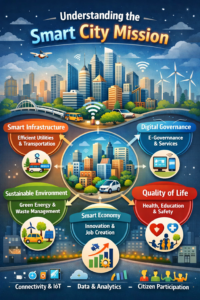
Understanding the Smart City Mission
The Smart City Mission (SCM) was launched in 2015 by the Ministry of Housing and Urban Affairs. Its objective is to promote cities that provide:
Core infrastructure
A clean and sustainable environment
A decent quality of life
Efficient and transparent governance
Unlike traditional city development models, the Smart City Mission focuses on area-based development and pan-city solutions, combining physical infrastructure with digital technology and citizen participation.
The mission covers over 100 cities across India, each implementing solutions based on local needs rather than a one-size-fits-all approach.
What Makes a City “Smart”?
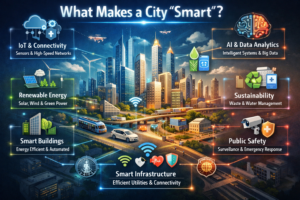
A smart city is not just about Wi-Fi or mobile apps. It is about smart planning, smart services, and smart people. Key components include:
Reliable water and electricity supply
Efficient public transport
Affordable housing
Waste management and sanitation
Digital governance (e-governance)
Safety and security systems
Sustainable and green practices
At the heart of all these components is the citizen, not technology.
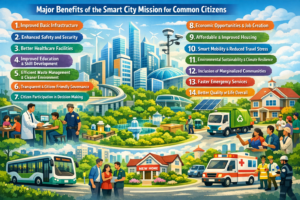
Major Benefits of the Smart City Mission for Common Citizens
1. Improved Basic Infrastructure
One of the most visible benefits of the Smart City Mission is better infrastructure.
Better Roads and Transportation
Citizens benefit from:
Well-maintained roads
Smart traffic management systems
Reduced congestion through intelligent signals
Dedicated lanes for pedestrians and cyclists
Public transport systems such as buses, metro connectivity, and electric vehicles are improved, making daily travel safer, faster, and more affordable.
Reliable Water and Electricity
Smart water meters, leak detection systems, and better pipelines ensure:
Reduced water wastage
Fair billing
Improved water availability
Similarly, smart electricity grids reduce power cuts and help citizens track consumption more accurately.
2. Enhanced Safety and Security
Safety is one of the most important concerns for common citizens, especially women, children, and senior citizens.
Smart cities use:
CCTV surveillance in public areas
Emergency response systems
Smart street lighting
Integrated command and control centers
These measures help reduce crime, improve law enforcement response time, and make public spaces safer—especially at night.
3. Better Healthcare Facilities
The Smart City Mission strengthens urban healthcare systems in several ways:
Digital health records
Telemedicine services
Smart ambulances with GPS tracking
Improved government hospitals and urban health centers
For citizens, this means:
Faster medical assistance in emergencies
Reduced waiting times
Better coordination between healthcare providers
This is particularly beneficial for low-income families who depend on public healthcare.
4. Improved Education and Skill Development
Education is a key pillar of inclusive growth, and smart cities support it through:
Smart classrooms in government schools
Digital libraries
Online learning platforms
Skill development centers
Students gain access to modern learning tools, while youth benefit from training programs aligned with job market needs, increasing employability.
5. Efficient Waste Management and Cleaner Environment
Garbage management has long been a challenge in Indian cities. Smart cities introduce:
Door-to-door waste collection
Waste segregation at source
Smart bins with sensors
Recycling and composting facilities
As a result, citizens experience:
Cleaner neighborhoods
Reduced health risks
Better air and water quality
Green spaces, urban parks, and tree-planting initiatives further improve mental and physical well-being.
6. Transparent and Citizen-Friendly Governance
One of the most powerful benefits of the Smart City Mission is e-governance.
Citizens can:
Pay bills online
Register complaints through mobile apps
Track service requests in real time
Access government information easily
This reduces corruption, eliminates middlemen, and saves time and effort for common people.
7. Citizen Participation in Decision-Making
Smart cities encourage citizens to participate actively in city planning through:
Public consultations
Online surveys and feedback portals
Resident welfare associations
City apps and social media platforms
When citizens are involved in decision-making, development becomes more relevant, inclusive, and effective.
8. Economic Opportunities and Job Creation
The Smart City Mission boosts the local economy by:
Attracting private investment
Supporting startups and innovation hubs
Creating jobs in construction, IT, services, and maintenance
Small businesses benefit from:
Better infrastructure
Digital payment systems
Improved market access
This leads to higher incomes and better living standards.
9. Affordable and Improved Housing
Affordable housing projects under smart city planning help address urban housing shortages. Benefits include:
Planned residential areas
Better sanitation and water supply
Access to public transport
Safer living conditions
Slum redevelopment projects aim to provide dignified housing with essential services, improving the lives of economically weaker sections.
10. Smart Mobility and Reduced Travel Stress
Daily commuting is a major stress factor for urban citizens. Smart mobility solutions include:
Real-time public transport tracking
Integrated ticketing systems
Smart parking solutions
Promotion of non-motorized transport
These initiatives reduce travel time, fuel consumption, and pollution, making city life more comfortable.
11. Environmental Sustainability and Climate Resilience
Smart cities focus on sustainable development by promoting:
Solar energy and renewable power
Rainwater harvesting
Energy-efficient buildings
Electric vehicles
Citizens benefit from:
Lower energy costs
Cleaner air
Reduced impact of climate change
Healthier living conditions
12. Inclusion of Marginalized Communities
The Smart City Mission aims to be inclusive, ensuring that benefits reach:
Urban poor
Women
Elderly citizens
Persons with disabilities
Features like barrier-free infrastructure, inclusive public spaces, and social welfare integration ensure that no one is left behind.
13. Faster Emergency Services
Integrated Command and Control Centers (ICCCs) act as the brain of smart cities. They help coordinate:
Police
Fire services
Ambulances
Disaster response teams
For citizens, this means quicker response during emergencies, potentially saving lives and property.
14. Better Quality of Life Overall
When infrastructure improves, services become efficient, and the environment becomes cleaner, the overall quality of life improves.
Citizens experience:
Less stress
Better health
More recreational spaces
Stronger community engagement
A smart city is not just a place to live—it becomes a place to thrive.
Challenges and the Road Ahead
While the Smart City Mission offers immense benefits, challenges remain, such as:
Project delays
Funding constraints
Digital divide
Need for stronger citizen awareness
However, continuous learning, technological innovation, and active public participation can help overcome these hurdles.

Conclusion
The Smart City Mission is not about building futuristic cities for a select few—it is about creating livable, inclusive, and sustainable cities for everyone.
For the common citizen, it means:
Better roads and transport
Cleaner surroundings
Safer neighborhoods
Faster services
Greater participation in governance
As the mission progresses, its real success will be measured not by technology installed but by how much easier, safer, and happier daily life becomes for ordinary people.
Smart cities are not just smart because of technology—they are smart because they put citizens at the center of development.
Сфера недропользования — это направление деятельности, связанный с разработкой подземных богатств.
Оно включает добычу полезных ископаемых и их дальнейшую переработку.
Данная сфера регулируется установленными правилами, направленными на охрану окружающей среды.
Эффективное управление в недропользовании обеспечивает устойчивое развитие.
оэрн