What is the Public Distribution System? Full Explanation
The Public Distribution System (PDS) is one of the most important social welfare mechanisms in India. It plays a crucial role in ensuring food security for millions of people, especially those belonging to economically weaker sections of society. Through this system, the government supplies essential food grains and commodities at subsidized prices to eligible households. Over the decades, the PDS has evolved in response to changing economic conditions, population growth, food production levels, and governance challenges.
Food security is not just about availability of food but also about accessibility and affordability. In a country like India, where income inequality and poverty remain significant challenges, the Public Distribution System acts as a safety net for vulnerable populations. This article provides a detailed, human-written explanation of the Public Distribution System, covering its meaning, objectives, history, functioning, types, benefits, challenges, reforms, and its overall significance in India’s socio-economic development.
What is the Public Distribution System (PDS)?
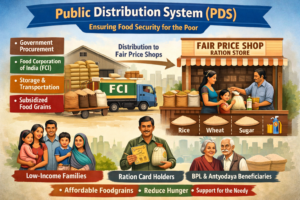
The Public Distribution System (PDS) is a government-sponsored program designed to distribute essential food commodities such as rice, wheat, sugar, and kerosene at subsidized prices to eligible citizens. It operates through a network of fair price shops, also known as ration shops, which are spread across urban and rural areas.
The primary aim of the PDS is to ensure that basic food items are available to all sections of society, particularly the poor and marginalized. By selling food grains at prices lower than market rates, the system helps reduce hunger, malnutrition, and food insecurity.
In India, the PDS is jointly managed by the central and state governments. While the central government is responsible for procurement, storage, and transportation of food grains, state governments handle the identification of beneficiaries and the distribution of food through fair price shops.
Historical Background of the Public Distribution System
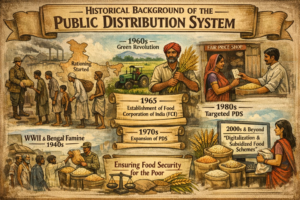
The roots of the Public Distribution System in India can be traced back to the British colonial period. During World War II, the government introduced rationing to manage food shortages and control prices. After independence in 1947, food security became a major concern due to frequent famines, low agricultural productivity, and a rapidly growing population.
In the 1950s and 1960s, India relied heavily on food imports, particularly under the PL-480 program from the United States. To manage the distribution of imported food grains, the government strengthened the PDS. The Green Revolution in the late 1960s significantly increased food grain production, allowing India to move toward self-sufficiency.
Over time, the PDS expanded its reach and scope. However, universal coverage led to issues such as high costs and leakages. To address these problems, the government introduced reforms, including the Targeted Public Distribution System (TPDS) in 1997, which focused on providing benefits specifically to poor households.
Objectives of the Public Distribution System
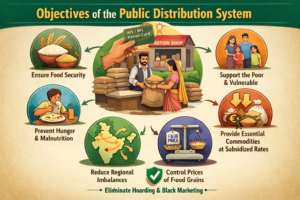
The Public Distribution System has several key objectives, which include:
- Ensuring Food Security – Providing regular access to essential food grains to prevent hunger and starvation.
- Supporting the Poor – Offering food at subsidized prices to low-income households.
- Price Stabilization – Controlling price fluctuations of essential commodities in the open market.
- Reducing Malnutrition – Improving nutritional intake among vulnerable groups.
- Disaster Relief – Supplying food during natural disasters, droughts, floods, or emergencies.
- Social Equity – Reducing inequality by supporting disadvantaged sections of society.
These objectives make the PDS a cornerstone of India’s social welfare framework.
How the Public Distribution System Works
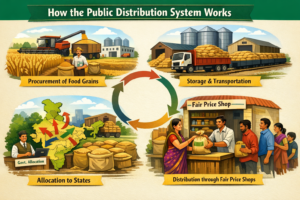
The functioning of the Public Distribution System involves multiple stages and agencies. Below is a step-by-step explanation:
1. Procurement of Food Grains
The central government procures food grains such as rice and wheat from farmers at a pre-declared Minimum Support Price (MSP). This procurement is mainly carried out by the Food Corporation of India (FCI) and state agencies. The MSP ensures that farmers receive fair prices for their produce.
2. Storage and Transportation
Once procured, food grains are stored in warehouses and godowns managed by the FCI. These grains are then transported to different states based on their requirements. Efficient storage and transportation are crucial to prevent spoilage and wastage.
3. Allocation to States
The central government allocates food grains to states under various schemes such as the National Food Security Act (NFSA). The quantity allocated depends on the number of eligible beneficiaries in each state.
4. Distribution through Fair Price Shops
State governments distribute the allocated food grains through a network of fair price shops. Beneficiaries purchase their monthly quota at subsidized rates using ration cards or digital authentication systems.
Types of Public Distribution System in India
Over the years, the PDS has evolved into different forms to improve efficiency and targeting.
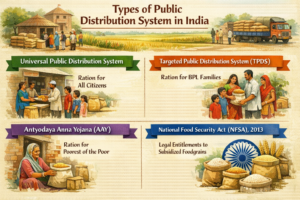
1. Universal Public Distribution System
Under the universal PDS, food grains were made available to all households, regardless of income level. While this approach ensured wide coverage, it also led to high costs and inefficiencies.
2. Targeted Public Distribution System (TPDS)
Introduced in 1997, the TPDS aimed to target benefits specifically to poor households. Beneficiaries were categorized into different groups based on economic status.
3. Antyodaya Anna Yojana (AAY)
Launched in 2000, this scheme focuses on the poorest of the poor. Eligible households receive food grains at highly subsidized prices.
4. National Food Security Act (NFSA), 2013
The NFSA gave legal backing to food security in India. It covers about two-thirds of the population and entitles beneficiaries to receive food grains at fixed subsidized prices.
Commodities Distributed under PDS
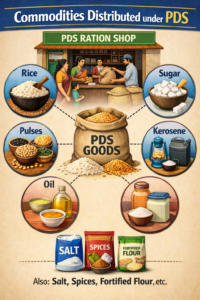
The main commodities distributed through the Public Distribution System include:
- Rice
- Wheat
- Coarse grains (in some states)
- Sugar
- Kerosene (being phased out in many areas)
Some states also distribute additional items such as pulses, edible oil, and salt through their PDS networks.
Benefits of the Public Distribution System
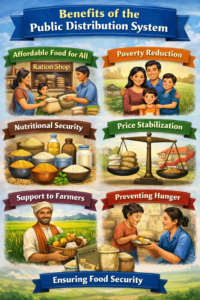
The PDS has several significant benefits:
- Reduces Hunger and Poverty – Ensures access to affordable food.
- Improves Nutritional Security – Helps meet basic dietary needs.
- Supports Farmers – MSP-based procurement benefits agricultural producers.
- Price Control – Stabilizes food prices in the market.
- Social Welfare – Acts as a safety net during economic or natural crises.
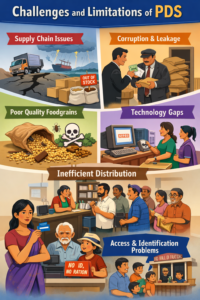
Challenges and Limitations of PDS
Despite its importance, the Public Distribution System faces several challenges:
- Leakage and diversion of food grains
- Corruption and black marketing
- Inclusion and exclusion errors
- Poor quality of food grains
- Inadequate storage infrastructure
- Lack of transparency in some regions
These issues reduce the effectiveness of the system and increase government expenditure.
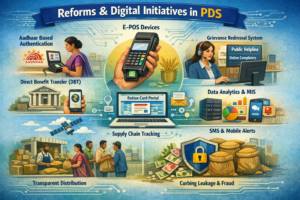
Reforms and Digital Initiatives in PDS
To address existing challenges, the government has introduced several reforms:
- Digitization of ration cards
- Aadhaar-based authentication
- One Nation One Ration Card scheme
- Use of electronic Point of Sale (ePOS) machines
- Direct Benefit Transfer (DBT) in some areas
These initiatives aim to improve transparency, reduce leakages, and enhance portability for migrant workers.
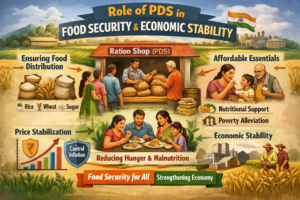
Role of PDS in Food Security and Economic Stability
The Public Distribution System plays a vital role in maintaining food security and economic stability in India. It ensures that even during inflation, economic slowdowns, or emergencies, essential food items remain accessible to the poor. During crises such as the COVID-19 pandemic, the PDS proved to be a lifeline for millions of households.
Conclusion
The Public Distribution System is a cornerstone of India’s social welfare and food security framework. Despite facing challenges related to efficiency and governance, it continues to support millions of people by providing affordable food grains. Continuous reforms, technological integration, and better monitoring are essential to strengthen the system further.
A well-functioning Public Distribution System not only addresses hunger and malnutrition but also promotes social equity and economic stability. As India moves forward, improving the effectiveness of the PDS will remain critical to achieving inclusive growth and ensuring that no one goes hungry.