PM Awas Yojana: Complete Application Process Guide (Step-by-Step)
Housing is one of the most basic human needs, yet for millions of families in India, owning a permanent home has long remained a distant dream. To address this challenge and ensure “Housing for All,” the Government of India launched Pradhan Mantri Awas Yojana (PMAY). This flagship housing scheme aims to provide affordable housing to economically weaker sections, low-income groups, and middle-income families across urban and rural India.
If you are planning to apply for PM Awas Yojana but are confused about eligibility, documents, benefits, or the application process, this detailed guide will help you understand everything clearly—from start to finish.
What Is Pradhan Mantri Awas Yojana (PMAY)?
Pradhan Mantri Awas Yojana (PMAY) is a central government initiative launched in 2015 with the goal of providing pucca houses with basic amenities to eligible Indian citizens.
The scheme focuses on:
Affordable housing
Financial assistance through subsidies
Inclusive development for urban and rural populations
PMAY is divided into two major components:
PMAY-Urban (PMAY-U)
PMAY-Gramin (PMAY-G)
Each component targets a specific population group with tailored benefits and application procedures.
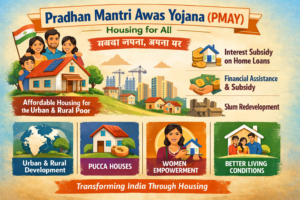
Objectives of PM Awas Yojana
The key objectives of PMAY include:
Providing affordable housing to poor and middle-income families
Improving living conditions in slums
Encouraging women empowerment through property ownership
Promoting eco-friendly and sustainable construction
Offering interest subsidies on home loans
Reducing homelessness in urban and rural areas
The broader vision is aligned with the government’s mission of “Housing for All”.
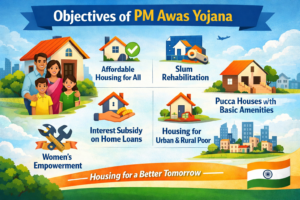
Types of PM Awas Yojana Schemes
1. PMAY-Urban (PMAY-U)
PMAY-Urban is designed for people living in cities and towns. It focuses on improving urban housing through four verticals:
a) In-Situ Slum Redevelopment (ISSR)
Redevelopment of slums using land as a resource
Beneficiaries receive pucca houses at the same location
b) Credit Linked Subsidy Scheme (CLSS)
Interest subsidy on home loans
Available for EWS, LIG, MIG-I, and MIG-II categories
c) Affordable Housing in Partnership (AHP)
Affordable housing projects in collaboration with public and private sectors
d) Beneficiary-Led Individual House Construction (BLC)
Financial assistance for individuals to construct or enhance their own houses
2. PMAY-Gramin (PMAY-G)
PMAY-Gramin focuses on rural households that:
Do not own a pucca house
Live in kutcha or dilapidated houses
Eligible beneficiaries receive direct financial assistance to build a permanent house with basic facilities such as electricity, sanitation, and drinking water.
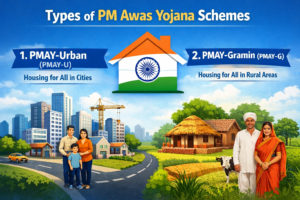
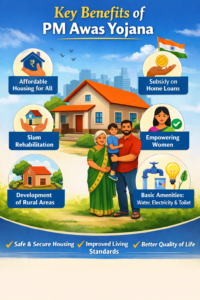
Key Benefits of PM Awas Yojana
Some of the major benefits of PMAY include:
Interest subsidy up to ₹2.67 lakh under CLSS
Financial assistance up to ₹2.5 lakh for house construction (varies by area)
Mandatory or preferred female ownership or co-ownership
Houses equipped with toilets, electricity, LPG connection, and water supply
Transparent Direct Benefit Transfer (DBT) system
Support for eco-friendly and disaster-resistant construction
PM Awas Yojana Eligibility Criteria
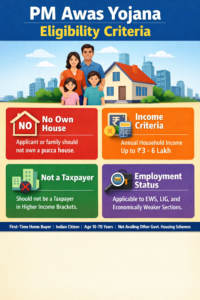
Eligibility varies depending on whether you are applying under PMAY-Urban or PMAY-Gramin.
General Eligibility Conditions
Applicant must be an Indian citizen
Applicant or family must not own a pucca house anywhere in India
Applicant must not have availed housing benefits from any other government scheme
Family includes husband, wife, and unmarried children
Income Categories Under PMAY-Urban
| Category | Annual Household Income |
|---|---|
| EWS (Economically Weaker Section) | Up to ₹3 lakh |
| LIG (Low Income Group) | ₹3–6 lakh |
| MIG-I | ₹6–12 lakh |
| MIG-II | ₹12–18 lakh |
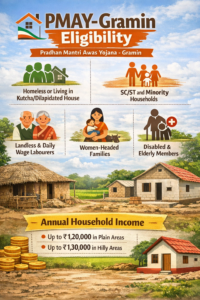
PMAY-Gramin Eligibility
Eligibility is based on:
Socio-Economic and Caste Census (SECC) data
Housing deprivation parameters
Priority given to SC/ST, minorities, widows, disabled persons, and senior citizens
Documents Required for PM Awas Yojana Application
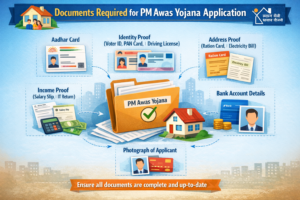
Before applying, keep the following documents ready:
Aadhaar Card
Identity proof (Voter ID / PAN / Driving License)
Address proof
Income certificate
Bank account details
Passport-size photographs
Property documents (if applicable)
Affidavit stating non-ownership of a pucca house
For PMAY-G, additional documents may be required by the Gram Panchayat.
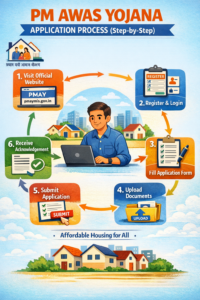
PM Awas Yojana Application Process (Step-by-Step)
How to Apply for PMAY-Urban (Online Process)
Step 1: Visit the Official Website
Go to the official PMAY-Urban portal:
https://pmaymis.gov.in
Step 2: Choose the Relevant Option
Click on “Citizen Assessment” and select:
“For Slum Dwellers” or
“Benefits under other 3 components”
Step 3: Enter Aadhaar Details
Enter your Aadhaar number
Verify using OTP
Step 4: Fill the Application Form
Provide details such as:
Personal information
Income details
Family details
Housing requirement
Bank account details
Step 5: Upload Documents
Upload scanned copies of required documents.
Step 6: Submit the Application
After verifying all details, submit the form and note the application reference number for future tracking.
How to Apply for PMAY-Urban (Offline Process)
You can also apply offline by:
Visiting a Common Service Centre (CSC)
Paying a nominal fee
Submitting documents and biometric verification
How to Apply for PMAY-Gramin
PMAY-G applications are not accepted online directly by individuals.
The process involves:
Identification of beneficiaries using SECC data
Verification by Gram Sabha
Approval by local authorities
Direct transfer of funds to beneficiary’s bank account
If eligible, your name will appear in the PMAY-G beneficiary list.
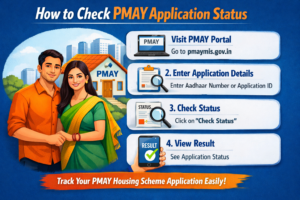
How to Check PMAY Application Status
Online Status Check (PMAY-Urban)
Visit pmaymis.gov.in
Click on “Search Beneficiary”
Select “Search by Name, Father’s Name & Mobile Number”
Enter required details
You can also check status using your assessment ID.
PMAY-Gramin Beneficiary List Check
Visit https://pmayg.nic.in
Click on “Stakeholders”
Select “IAY/PMAYG Beneficiary”
Enter details such as state, district, and block
PMAY Credit Linked Subsidy Scheme (CLSS) Explained
Under CLSS, beneficiaries can get interest subsidies on home loans:
| Category | Interest Subsidy | Loan Amount |
|---|---|---|
| EWS/LIG | 6.5% | Up to ₹6 lakh |
| MIG-I | 4% | Up to ₹9 lakh |
| MIG-II | 3% | Up to ₹12 lakh |
The subsidy is credited directly to the loan account, reducing EMIs.
Common Reasons for PMAY Application Rejection
Some common reasons include:
Incorrect or false information
Income exceeding eligibility limits
Ownership of a pucca house
Aadhaar mismatch
Duplicate applications
Always double-check details before submission.
Tips to Increase Chances of Approval
Ensure Aadhaar and bank details are accurate
Apply under the correct income category
Prefer female ownership or co-ownership
Keep all documents updated
Track application status regularly
PM Awas Yojana: Challenges and Limitations
While PMAY has helped millions, some challenges remain:
Delays in construction
Land availability issues in urban areas
Awareness gaps in rural regions
State-level implementation differences
Despite these challenges, PMAY remains one of India’s most impactful social welfare schemes.
Conclusion
Pradhan Mantri Awas Yojana is a transformative initiative that has changed the lives of millions by turning the dream of home ownership into reality. Whether you live in a city or a village, PMAY offers a structured, transparent, and financially supportive path to owning a house.
By understanding the eligibility criteria, benefits, and application process clearly, you can avoid mistakes and increase your chances of approval. If you or your family meet the criteria, applying for PM Awas Yojana can be a crucial step toward a secure and dignified life.