
Ration Card Types and Eligibility Criteria in India
In India, a ration card is one of the most important government documents for households, especially for families belonging to economically weaker sections. It not only allows citizens to purchase essential commodities like rice, wheat, sugar, and kerosene at subsidized rates through the Public Distribution System (PDS), but it also serves as an identity and address proof in many situations.
Over the years, the Government of India has introduced different types of ration cards to ensure that subsidies reach the right beneficiaries. Each ration card type is issued based on a family’s income level and economic status. Understanding the different ration card categories and eligibility criteria can help citizens determine which type they qualify for.
This article explains the various types of ration cards in India and the eligibility criteria for each category.
Here is what you want Income Tax Slab Changes Explained for 2026 (Old vs New Regime)
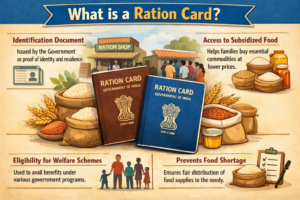
What is a Ration Card?
A ration card is an official document issued by state governments in India. It enables eligible households to purchase essential food items at subsidized prices through Fair Price Shops (FPS) under the Public Distribution System.
The system was designed to ensure food security for the country’s population, especially those living below the poverty line.
Apart from accessing subsidized food grains, ration cards are also used for several other purposes such as:
-
Identity proof
-
Address proof
-
Applying for government schemes
-
Opening bank accounts
-
Getting LPG connections
-
School admissions in some cases
Today, with the introduction of the One Nation One Ration Card (ONORC) system, beneficiaries can even access ration benefits from anywhere in India.
Types of Ration Cards in India
Different states may use slightly different colors or names for ration cards, but the categories generally fall into the following major groups.
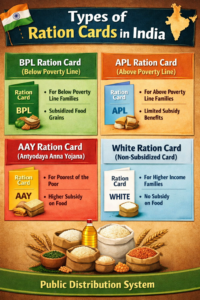
1. Antyodaya Anna Yojana (AAY) Ration Card
The Antyodaya Anna Yojana (AAY) ration card is issued to the poorest families in the country. This scheme was launched in 2000 by the Government of India to support households that are in extreme poverty.
Families holding this card receive food grains at the highest level of subsidy under the Public Distribution System.
Key Benefits
AAY cardholders receive 35 kilograms of food grains per family per month at highly subsidized prices.
Typical subsidized prices include:
-
Rice – around ₹3 per kg
-
Wheat – around ₹2 per kg
These prices may vary slightly depending on state policies.
Eligibility Criteria
Families that may qualify for AAY cards include:
-
Landless agricultural laborers
-
Daily wage laborers
-
Rural artisans and craftsmen
-
Widows with no stable income
-
Elderly people without financial support
-
Disabled individuals without regular income
-
Tribal households with very low income
The government identifies these families through poverty surveys and socio-economic data.
2. Below Poverty Line (BPL) Ration Card
The BPL ration card is issued to families whose income falls below the poverty line determined by the government.
These families receive subsidized food grains under the Public Distribution System but usually at a slightly lower level of subsidy than AAY beneficiaries.
Benefits of BPL Card
BPL cardholders can purchase essential food items such as:
-
Rice
-
Wheat
-
Sugar
-
Kerosene
-
Pulses (in some states)
The quantity and prices vary depending on state government policies.
Eligibility Criteria
Families are considered eligible for a BPL card if:
-
Their annual income is below the poverty line set by the state government
-
They do not own large agricultural land
-
They have limited or no stable employment
-
Their living conditions indicate economic hardship
The government often uses the Socio-Economic Caste Census (SECC) data to determine eligibility.
3. Above Poverty Line (APL) Ration Card
The APL ration card is issued to families whose income is above the poverty line. These households are relatively better off compared to BPL families.
APL cardholders may receive limited or fewer subsidies compared to BPL or AAY beneficiaries.
Benefits
While the subsidies are not as significant, APL cardholders can still access certain benefits such as:
-
Purchasing food grains at government-regulated prices
-
Using the ration card as identity proof
-
Eligibility for some state government schemes
Eligibility Criteria
To qualify for an APL ration card:
-
The family’s annual income must be above the poverty line
-
They must be residents of the state where they apply
-
They should not already possess a BPL or AAY card
APL cards mainly function as a general household ration card for middle-income families.
4. Priority Household (PHH) Ration Card
After the implementation of the National Food Security Act (NFSA) 2013, many states introduced the Priority Household (PHH) category.
This category replaced some of the earlier classifications like BPL in certain states.
Benefits
PHH beneficiaries are entitled to receive 5 kilograms of food grains per person per month at subsidized prices.
Typical subsidized rates include:
-
Rice – ₹3 per kg
-
Wheat – ₹2 per kg
-
Coarse grains – ₹1 per kg
Eligibility Criteria
Households eligible under PHH typically include:
-
Low-income families
-
Small and marginal farmers
-
Landless laborers
-
Workers in the informal sector
-
Households identified in the SECC data
The exact criteria may vary between states.
Color Codes of Ration Cards
Many states use different color codes to distinguish ration card categories. Though the colors can vary, some commonly used ones include:
| Color | Category |
|---|---|
| Yellow | BPL families |
| Pink | APL families |
| White | General category |
| Blue | Priority households |
| Green | Antyodaya Anna Yojana |
Since ration cards are issued by state governments, the colors and designs can differ from state to state.
Eligibility Criteria for Obtaining a Ration Card
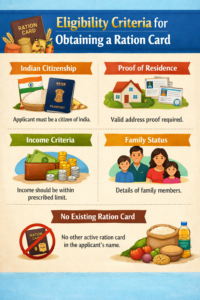
Although the specific rules vary by state, the general eligibility requirements for obtaining a ration card include:
1. Residency Requirement
Applicants must be permanent residents of the state where they apply for the ration card.
2. No Existing Ration Card
The applicant or family should not already possess another ration card in the same or different state.
3. Family Details
The application must include details of all family members such as:
-
Name
-
Age
-
Aadhaar number
-
Relationship to head of family
4. Income Criteria
The family’s annual income determines whether they qualify for AAY, BPL, PHH, or APL categories.
5. Identity and Address Proof
Applicants must provide documents such as:
-
Aadhaar Card
-
Voter ID
-
Electricity bill
-
Driving license
-
Passport
These documents help verify identity and residence.
How to Apply for a Ration Card
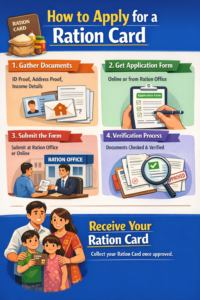
Today, applying for a ration card has become easier because most states offer both online and offline application methods.
Online Application
Applicants can visit their state’s food and civil supplies department website and:
-
Fill out the ration card application form
-
Upload required documents
-
Submit the form online
-
Track application status
Offline Application
Applicants can also apply by visiting:
-
Local ration office
-
MeeSeva centers
-
Common Service Centers (CSC)
After verification, the ration card is issued to the eligible household.
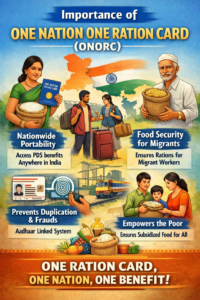
Importance of the One Nation One Ration Card (ONORC)
The One Nation One Ration Card (ONORC) scheme was introduced to make the Public Distribution System more accessible.
This initiative allows beneficiaries to access subsidized food grains from any Fair Price Shop across India, regardless of the state where the ration card was issued.
This is especially beneficial for:
-
Migrant workers
-
Laborers moving between states
-
Temporary workers in cities
It ensures that people do not lose access to food security benefits when they relocate.
Common Uses of a Ration Card
Apart from purchasing food grains, ration cards serve multiple purposes in India.
They can be used for:
-
Identity verification
-
Address proof
-
Applying for government welfare schemes
-
Getting LPG gas connections
-
Applying for voter ID
-
School or college admissions in some cases
Because of these uses, ration cards remain one of the most important documents for many households.
Conclusion
Ration cards play a crucial role in ensuring food security and social welfare in India. By categorizing households into different groups such as AAY, BPL, APL, and PHH, the government can provide targeted subsidies to families based on their economic condition.
Understanding the different types of ration cards and their eligibility criteria helps citizens determine which category they fall under and how they can benefit from the Public Distribution System.
With digital systems and initiatives like the One Nation One Ration Card, access to subsidized food and government welfare programs is becoming more efficient and inclusive across the country.